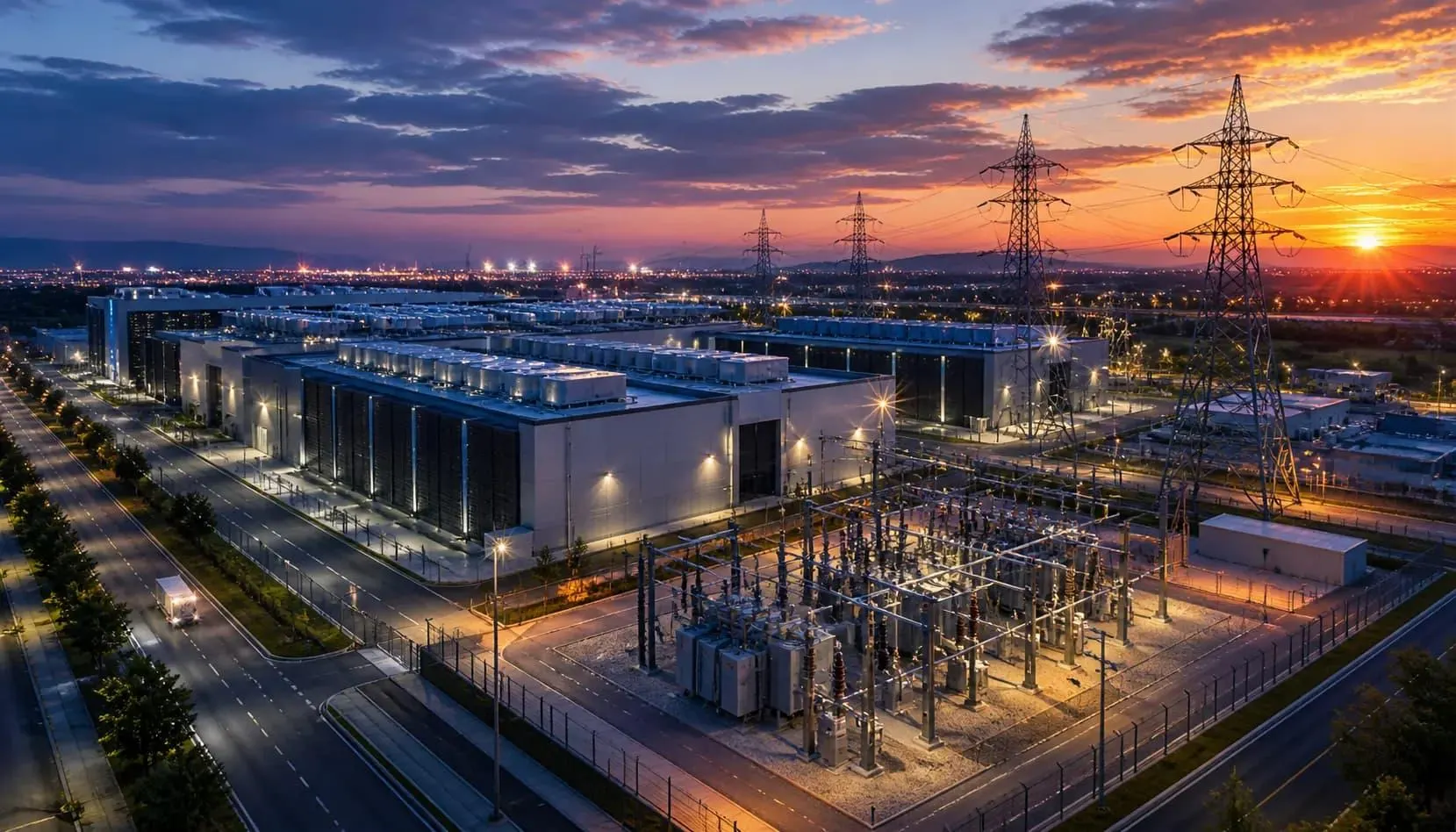
The data center industry is experiencing one of the largest infrastructure investment cycles in its history.
Artificial intelligence has accelerated demand for computing resources, while cloud adoption, digital services, and enterprise modernization continue to support underlying infrastructure requirements.
The International Energy Agency estimates that global data center electricity demand could rise from 485 TWh in 2025 to approximately 950 TWh by 2030.
But a growing market does not guarantee attractive returns for every participant.
The next decade will test the ability of developers, operators, infrastructure buyers, and investors to distinguish genuine long-term demand from capacity built on optimistic assumptions.
The central question is shifting from how much infrastructure the world needs to which infrastructure can be delivered economically and utilized sustainably.
1. Power Availability Will Become a Competitive Advantage
For decades, data center development decisions emphasized connectivity, location, land, and customer proximity.
Those factors remain important.
But access to reliable electricity is becoming a central determinant of project viability.
Power availability influences construction timelines, location selection, facility design, and operating costs.
A site with an attractive land price may have limited value if its electrical connection cannot be delivered for several years.
Conversely, a location with credible access to power may command a premium even if it sits outside a traditional data center market.
This does not mean electricity is the only constraint.
Power must be accompanied by appropriate network connectivity, infrastructure, financing, and customer demand.
The strategic asset is not electricity in isolation. It is the ability to convert electricity into dependable, commercially useful computing capacity.
2. Announced Capacity Will Be Scrutinized More Closely
Infrastructure announcements often emphasize total planned megawatts or gigawatts.
But the distinction between proposed, permitted, financed, under-construction, and operational capacity is substantial.
A project may have secured land but not power.
It may have a utility agreement but lack financing.
It may be under construction but already fully committed to tenants.
As capital requirements increase, buyers and investors will need to distinguish development ambition from executable supply.
One useful way to evaluate projects is to ask:
- Is the power connection secured and deliverable?
- Is financing committed?
- Are the technical specifications aligned with customer demand?
- What construction and equipment dependencies remain?
- How much capacity is already contracted?
- What is the credible commissioning schedule?
Headline capacity is a starting point, not a substitute for diligence.
3. AI Will Create Winners and Losers Within the Same Market
It is tempting to treat all AI-related infrastructure demand as equivalent.
It is not.
Training, inference, enterprise AI, research computing, and general-purpose cloud workloads can have different technical and economic requirements.
The economics also evolve as hardware performance, model efficiency, and customer adoption change.
A facility optimized for one generation of computing hardware may require upgrades to support the next.
A location suitable for training may be unattractive for latency-sensitive applications.
A data center operator can therefore be exposed to strong overall AI demand while still owning assets that are poorly positioned for particular customer segments.
The ability to adapt facilities and commercial structures will matter.
4. Capital Discipline Will Separate Growth From Value Creation
Building data centers requires substantial upfront investment.
Infrastructure providers must commit capital to land, power systems, cooling, equipment, construction, and operations.
The financial returns depend on customer commitments, utilization, operating costs, and the cost of capital.
Strong demand can support investment, but it can also encourage aggressive assumptions.
Long-term infrastructure contracts can provide predictable revenue. They can also create exposure if customers lack the financial strength to honor commitments.
For operators, customer credit quality and contract durability are as important as headline leasing demand.
For buyers, financial stability of the operator matters because infrastructure must remain reliable over many years.
The strongest projects will be those where physical infrastructure, customer demand, and financing structures reinforce each other.
5. Flexibility Will Become More Valuable
Infrastructure development operates on long timelines.
Technology and customer requirements can change much faster.
This creates a strategic advantage for assets and contracts that can adapt.
Technical flexibility may involve cooling configurations, power density, and network architecture.
Commercial flexibility may involve phased commitments, expansion options, and deployment timing.
Geographic flexibility may allow customers to compare several markets rather than depend on one constrained location.
None of these forms of flexibility is free.
Operators must balance customer optionality against the certainty required to finance infrastructure.
The challenge is to create structures that allocate risk sensibly between both parties.
6. Geographic Diversification Will Be Selective
The world's computing infrastructure may become more geographically distributed.
Power constraints and land availability are already encouraging development beyond established markets.
But geography will remain workload-dependent.
A location that works for large-scale training may be unsuitable for applications requiring low latency to North American or European customers.
Regulation, export controls, network costs, and operational resilience will continue to influence decisions.
Emerging regions will need to compete on deliverable infrastructure rather than investment announcements alone.
This creates an opportunity for locations with credible power, connectivity, commercial frameworks, and operating capabilities.
It does not guarantee that every ambitious new market will succeed.
7. Better Market Information Will Matter More
As infrastructure requirements become more complex, buyers need more than facility directories.
They need to understand which capacity is actually available, when it can be commissioned, and how its technical and commercial characteristics compare.
Operators need to identify customers whose requirements align with their infrastructure and financial objectives.
Investors need to separate contracted demand from speculative development pipelines.
Better information cannot eliminate physical shortages.
But it can reduce misallocation, improve procurement decisions, and help existing infrastructure reach suitable customers.
What We Would Watch Over the Next Five Years
Rather than focusing exclusively on announcements of new data center capacity, five indicators deserve attention.
Delivered power versus announced power: How much planned capacity actually becomes operational?
Preleasing and customer concentration: Is demand diversified, contracted, and supported by credible counterparties?
Deployment timelines: Are power, construction, and equipment delays improving or worsening?
Workload economics: How are GPU efficiency, utilization, and customer demand changing infrastructure requirements?
Geographic price differences: Are emerging markets offering sustainable cost advantages after accounting for connectivity, compliance, and operational risk?
Together, these indicators provide a more useful picture of the industry's direction than headline investment totals alone.
The Next Infrastructure Advantage
The data center market is entering a phase in which physical constraints and commercial execution are becoming inseparable.
Power availability matters.
Financing matters.
Technical design matters.
Customer quality matters.
And the ability to match real demand with deliverable infrastructure matters.
The industry will continue to build.
But the most important measure of progress will not be the number of gigawatts announced.
It will be how efficiently capital, power, and infrastructure are converted into computing capacity that customers can actually use.
Megvia connects global infrastructure demand with data center operators, helping customers source, compare, and negotiate colocation and AI-ready capacity.
Explore Megvia: megvia.com
Research: International Energy Agency, Key Questions on Energy and AI (2026); CBRE, Global Data Center Trends 2026.
Looking for data center capacity? Explore Megvia.